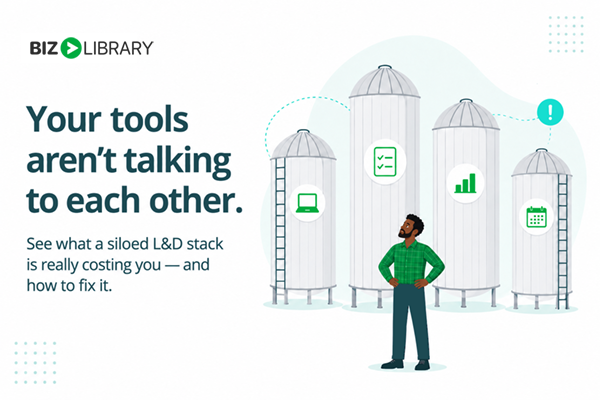

Somewhere in your organization right now, there’s a spreadsheet nobody remembers building, tracking completion rates from a compliance tool that IT forgot to deprovision when the old vendor contract lapsed. It’s not malicious. Nobody sat down and decided to build a Frankenstein’s monster of an L&D tech stack. It just happened, one reasonable-sounding purchase at a time, until “reasonable” added up to a mess.
One Scroll-Stopping Stat:
HR tech sprawl is up more than 160%, according to Sapient Insights Group. Organizations are running an average of 26 HR tech modules — compared to 10 modules just a few years before.
And it tracks with what you’re probably staring at right now: an LMS here, an LXP there, a separate compliance tracker nobody quite trusts, an ATS that doesn’t talk to any of it, and a BI dashboard team stitching together exports by hand every quarter so you have something to bring to the CFO. And that doesn’t even cover the new AI tools the board is pushing for — what a mess.
None of these purchases were wrong in isolation. That’s the trap. Sprawl doesn’t happen because anyone makes a bad decision. It happens because everyone makes a series of individually good ones, with nobody responsible for the whole picture.
Hidden Costs of a Fragmented L&D Tech Stack
The subscription line items are the visible cost. The hidden ones are worse.
Wasted spend. Torii’s 2025 SaaS Benchmark Report found that organizations waste more than $1 million annually on SaaS tools that were purchased but go largely unused, with over 60% of software applications sitting inactive while companies keep paying for them. Separately, SaaS management firm Zylo has found that companies license an average of 275+ applications but only get real usage out of about half of what they’re paying for. If that ratio holds anywhere near your L&D stack, you’re not looking at a rounding error. You’re looking at a budget line your CFO would very much like explained.
IT overhead you didn’t budget for. Every point solution that doesn’t talk natively to your other systems needs someone to build, monitor, and eventually fix the bridge between them. If your team runs lean on IT support (and if you’re managing 250 to 10,000 employees without a dedicated integrations engineer, you probably are), that bridge-building falls on whoever’s most stubborn about getting the reports to match.
Data fragmentation, right when you need clarity most. You already know this pain: pulling together a defensible picture of L&D’s impact means logging into three or four systems, exporting to Excel, and hoping the date ranges actually line up, instead of pulling it from a single reporting dashboard. That’s not a reporting problem. That’s an architecture problem wearing a reporting problem’s clothes.
Software that refuses to die. Once a tool stops being useful, getting rid of it is its own project. Multiple stakeholders have to sign off, contracts have renewal clauses designed to outlast your patience, and data has to migrate somewhere before anyone’s comfortable pulling the plug. The result: unused software often lingers for months after everyone privately agrees it should go.
Why L&D Teams Struggle with HR Tech Sprawl
This isn’t random. Harsh Kundulli, VP and HR technology analyst at Gartner, put his finger on the actual mechanism in a recent conversation with SHRM: without a coordinated HR technology roadmap, “you might see many different HR functional leads, like the head of a recruiting or a learning center of excellence, invest separately in their own technologies because of their own priorities.” Recruiting buys what recruiting needs. Learning buys what learning needs. Nobody’s wrong, and nobody’s talking to each other, and eighteen months later you’ve got a stack that looks less like an org chart and more like a ransom note cut from different fonts.
L&D gets hit particularly hard because it sits at the intersection of so many other systems: it needs to know who was hired (ATS), what they’re being measured on (performance management), what they’ve completed (LMS), what they’re actually engaging with versus what they’re being forced through (LXP, if you have one), and how any of it connects to retention or promotion (BI/analytics). That’s five potential seams, and every seam is a place where data goes to get lost.
How to Build the Financial Case for L&D Tech Consolidation
Here’s the reframe that matters: your CFO doesn’t care whether the LMS is “nice.” They care about total cost of ownership, and right now, most of that cost is invisible to them because it’s spread across line items that don’t obviously connect. Gartner’s own research puts average enterprise SaaS overspend at around 25%, driven almost entirely by exactly this kind of fragmentation: licenses bought for capacity nobody uses, tools kept “just in case,” integrations maintained by sheer institutional memory.
When you walk into that budget conversation, the strongest position isn’t “our LMS needs an upgrade.” It’s “here’s what the current sprawl is actually costing us, and here’s what consolidating it buys back.” That’s a finance conversation, not a training conversation, and it’s the one that actually gets budget approved.
Want help building the business case?
See how BizLibrary helps L&D leaders make the financial case for integrated solutions — not just the training case.
HCM Learning Modules vs. Integrated LMS Platforms: What’s the Difference?
This is the fork most L&D leaders hit eventually, and it deserves an honest answer instead of a sales pitch, because both paths are genuinely defensible depending on where you’re starting from.
The case for your HCM’s built-in L&D module. If your core need is basic compliance tracking, minimal content variety, and you’d rather have one login and one invoice than manage another vendor relationship, the module bundled into your HCM suite might be all you ever need. Data lives natively alongside performance and comp data. No integration work required. For a lot of organizations, that’s genuinely the right call, and if that’s you, this whole conversation is moot.
Where it tends to break down. The catch is that HCM suites weren’t built to be the best learning platform on the market. They were built to be the best system of record, with learning as one module among many. Gartner’s own research, per Kundulli, found that most large and midsize organizations running all-in-one HCM suites still end up augmenting them with specialized point systems, because “the pace of innovation and change is so fast now that no HCM suite can hope to keep up with it.” Translation: even organizations that chose the bundled path often quietly end up bolting something else on anyway, just without a plan for how it fits, which is exactly how you land back at 26 modules.
The tell is usually content depth and reporting. Bundled modules tend to plateau: fine for check-the-box compliance, thin on the kind of content library, skills pathways, and leadership development tracks that actually move the needle on retention. And when your CFO asks how learning investment connects to promotion readiness or turnover risk, a compliance-tracking module usually wasn’t built to answer that question.
The case for an integrated, purpose-built platform. Sapient Insights Group’s own research describes what buyers actually want as a “cluster” approach: an anchor system (often the HCM) with a small number of deeply integrated, best-in-class satellites around it, rather than either extreme. As Stacey Harris, Sapient’s chief research officer, put it, HR buyers are “tired both of the all-in-one approach and the point system approach because neither of those two models have really worked for them.” The cluster model isn’t more sprawl. Done right, it’s one clean, well-integrated addition that closes a real capability gap, instead of five uncoordinated tools bolted on with no plan.
The practical test: does the new system replace tab-switching and manual exports, or does it add another tab? If a platform genuinely integrates with your existing ATS and BI tools rather than sitting beside them as one more silo, it’s solving the actual problem. If it doesn’t, you’ve just added module 27.
How to Audit Your L&D Tech Stack Before You Buy
Whichever direction you’re leaning, do this first. It costs nothing but time, and it’s the foundation of the business case you’ll eventually bring upstairs.
Inventory everything. List every L&D-adjacent system currently in use, including the ones nobody remembers approving. SHRM’s reporting found that fewer than half of HR departments keep a running inventory of their software at all, and nearly one in five aren’t even fully aware of everything they own. You cannot fix what you haven’t listed.
Audit actual usage, not license counts. How many people log in monthly versus how many seats you’re paying for? This number is almost always more embarrassing than expected.
Map the integrations, and the manual workarounds. Where does data flow automatically, and where does someone export a CSV and pray? Every manual step is a future point of failure and a hidden labor cost.
Build a retirement plan before you build a purchase plan. Decide what gets sunset as part of any consolidation, not after. Software that’s “no longer useful” but still on the books tends to linger for months once nobody makes it someone’s explicit job to kill it.
The ROI of a Consolidated L&D Platform
This is the part where we stop pretending BizLibrary is a neutral bystander in this conversation, because it isn’t, and you’d see through it if we tried.
BizLibrary is built around the cluster model Sapient describes: one anchor learning platform, integrated cleanly with the HCM, ATS, and BI tools you’re already running, rather than one more disconnected point solution competing for a tab in your browser. That means the reporting problem gets solved at the architecture level. Instead of exporting from four systems to build a quarterly deck, the data your CFO actually wants (completion, engagement, skills progression, and how it ties to retention and promotion) lives in one place from the start.
White-glove onboarding, not another IT project.
A dedicated implementation team handles the heavy lifting of migration and integration, so switching platforms doesn’t become the six-month project that talks you out of ever doing it.
Request a demoThe migration itself is usually where L&D leaders get nervous, and fairly so given how thin IT support tends to run at this scale. That’s exactly why white-glove onboarding isn’t a throwaway line in a sales deck here.
And because leadership pipeline health is one of the metrics you’re most often asked to defend, that reporting is built in rather than bolted on. Not “here’s a course completion chart,” but a real picture of whether the people you’re developing are actually ready for what’s next, tied to the retention and promotion data that already lives in your other systems.
None of this is a claim that a bundled HCM module is always wrong. It’s a claim that if you’ve already found yourself stitching together spreadsheets to answer questions your systems should be answering natively, the cost of that sprawl is higher than it looks, and a consolidated platform pays for the gap it closes faster than most people expect.
Next Steps: Fixing Your L&D Tech Stack
If you recognize your own stack in the 26-modules number, or if you’ve caught yourself explaining to your CFO why the L&D numbers don’t quite match the HR numbers, the audit above is genuinely worth doing before anyone pitches you anything, ours included. It’ll tell you whether you’re dealing with a training problem or an architecture problem, and those two get solved very differently.
If it turns out to be the latter, let’s talk.
We’ll walk through your specific setup rather than a generic pitch deck.
