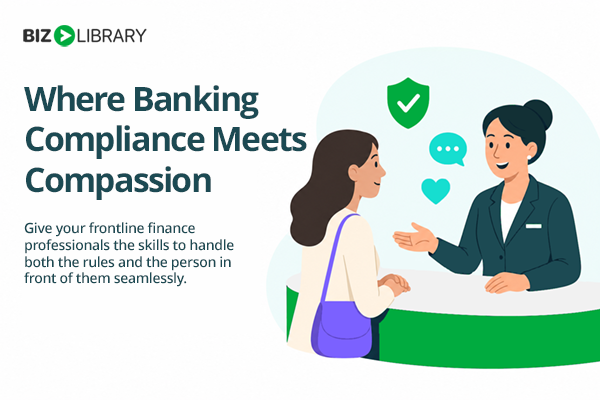

How to Improve Customer Service in Banking When Every Interaction Doubles as a Compliance Check
Picture this: it’s 4:45 on a Friday. The line’s out the door. A customer is standing at the counter, visibly stressed, because their direct deposit hasn’t landed and rent is due tomorrow.
Your teller has about thirty seconds to calm this person down, explain what’s happening, and — quietly, in the back of their mind — clock whether anything about this interaction needs a second look. Because in banking, “just a customer service issue” and “potential compliance flag” often show up wearing the same outfit.
Welcome to banking customer service. It’s not harder because the people doing it care less. It’s harder because it’s doing two jobs at once, in the same sixty seconds, every single time.
Why Banking Customer Service Plays a Different Game
Every industry insists its customer service is special. In banking, it actually is — and it’s not about being extra polite. It’s about what’s riding on the interaction.
If a barista gets your order wrong, you’re mildly annoyed. If a bank employee mishandles a moment, the fallout looks different: a missed fraud signal, a loan denial explained badly enough to trigger a fair lending complaint, a vulnerable customer who needed someone to notice something was off — and nobody did.
The research backs up what anyone who’s worked a teller line already knows. Frontline bank employees have intense, near-constant face-to-face and voice-to-voice interactions — handling transactions, requests, and complaints all day long. And unlike most customer-facing jobs, bank employees are also expected to stay current on constantly shifting regulations while handling sensitive financial information and maintaining accuracy — all while smiling and making Mrs. Patterson feel like her overdraft fee dispute matters (because it does).
So if you’re wondering how to improve customer service in the banking industry, the first move is dropping the idea that this is “customer service, but for banks.” It’s its own discipline, with its own rulebook, and it deserves training that treats it that way.
Compliance and customer service shouldn’t live in separate training tracks.
See how BizLibrary builds frontline training that treats regulatory knowledge and people skills as one connected skill set.
The Compliance Layer Hiding Inside Every Conversation
Here’s the thing about compliance training: most of it lives in a separate lane from customer service training. BSA/AML modules over here, de-escalation tips over there, never the two shall meet.
But that’s not how it actually plays out on the floor. Compliance doesn’t announce itself. It shows up disguised as an ordinary conversation.
Take elder financial exploitation — maybe the single best example of where “soft skill” and “compliance obligation” are actually the same skill. On paper, it’s a SAR-filing requirement. In real life, it’s a teller noticing that something about a customer’s demeanor feels off, asking one more gentle question, and trusting that instinct enough to slow things down.
And the payoff is real. In a six-month study of more than 1,800 bank employees across roughly 500 branches, employees trained to spot exploitation halted nearly $1 million in fraudulent transactions — twelve times more per employee than untrained staff — and saved customers an average of $865 each, compared to just $70 for employees without training. Trained staff also reported suspicious incidents five times as often and protected sixteen times more money for older clients.
Here’s the detail that should reframe how you think about “compliance training” entirely: the most effective programs teach staff to recognize signs of dementia and other vulnerability cues in the people sitting across from them. That’s not a banking compliance regulation. That’s emotional intelligence wearing a compliance badge.
If your bank employee training courses treat compliance and customer service as two separate binders, you’re only training for half the job.
One platform for compliance training and frontline skills.
See how BizLibrary supports banks, credit unions, and financial services teams from onboarding through audit-ready reporting.
The Customer Service Skills That Actually Carry This Work
Let’s get practical. Improving customer service in the banking sector isn’t about memorizing more rules — it’s about building a specific set of banking skills that show up across every frontline role, whether someone’s behind the counter, on the phone, or reviewing a loan file.
Here’s what actually matters, regardless of job title:
- Staying steady when someone else isn’t. Every frontline role absorbs someone else’s financial stress, multiple times a day. Frontline employees like tellers serve as the intermediary between the bank and the public — which means they’re also the shock absorber. That’s a real skill, and it’s trainable.
- Making judgment calls that actually matter. A teller deciding whether a transaction needs a second look. A lender sensing something’s off about an application. A contact center rep quietly verifying that the person on the phone is really who they say they are. Different scenes, same muscle: reading a situation accurately, fast.
- Patience that doesn’t slip into autopilot. The elder fraud numbers prove this isn’t optional. It takes real patience to stay present with someone who’s confused, scared, or possibly being coached by someone standing just out of frame.
- Explaining “no” without sounding like a legal disclaimer. Every frontline employee has to deliver a denial, a hold, or a documentation request in a way that still feels human. That’s a genuine communication skill — and one most training programs skip entirely.
- Knowing exactly when to hand it off. Recognizing the edge of your own authority and looping in the right person, calmly, before a small thing becomes a big thing.
None of this shows up in a job posting, or in just one training module. All of it shows up in the moment a customer decides whether they trust your institution or not.
The Real Goal of Bank Teller Training
Let’s go back to that teller at 4:45 on a Friday.
The customer’s still standing there, stressed about rent. But here’s what a well-trained teller actually does with that thirty-second window: she stays calm, walks the customer through exactly what’s happening with the deposit, and pulls up the timeline together so it’s not just “I don’t know” — it’s “here’s what I’m seeing, and here’s when it should post.” She also notices the customer seems more shaken than a late deposit really explains, so she asks one more gentle question. Turns out it’s not just the rent — it’s been a rough month. Nothing flags as a compliance concern, but the customer leaves feeling heard instead of dismissed.
Deposit shows up Monday morning, like it always does. But the story that customer tells their friends isn’t about the delay. It’s about the teller who actually listened.
That’s the version of banking customer service worth building toward. Not a team that just avoids getting sued or fined — a team that turns stressful moments into the reason people stay loyal to your institution for another twenty years.
Getting there doesn’t take a miracle. It takes ongoing bank teller training and role-relevant bank employee training programs that treat compliance knowledge and human skills as one connected discipline instead of two separate checklists.
Do that well, and every one of those thirty-second conversations becomes a chance to prove your institution deserves the trust people put in it — one Friday afternoon at a time.
Great frontline training only counts if you can prove it happened.
Learn what to look for in a banking LMS — from audit-ready reporting to role-based compliance content that actually holds up on exam day.
Read the guide