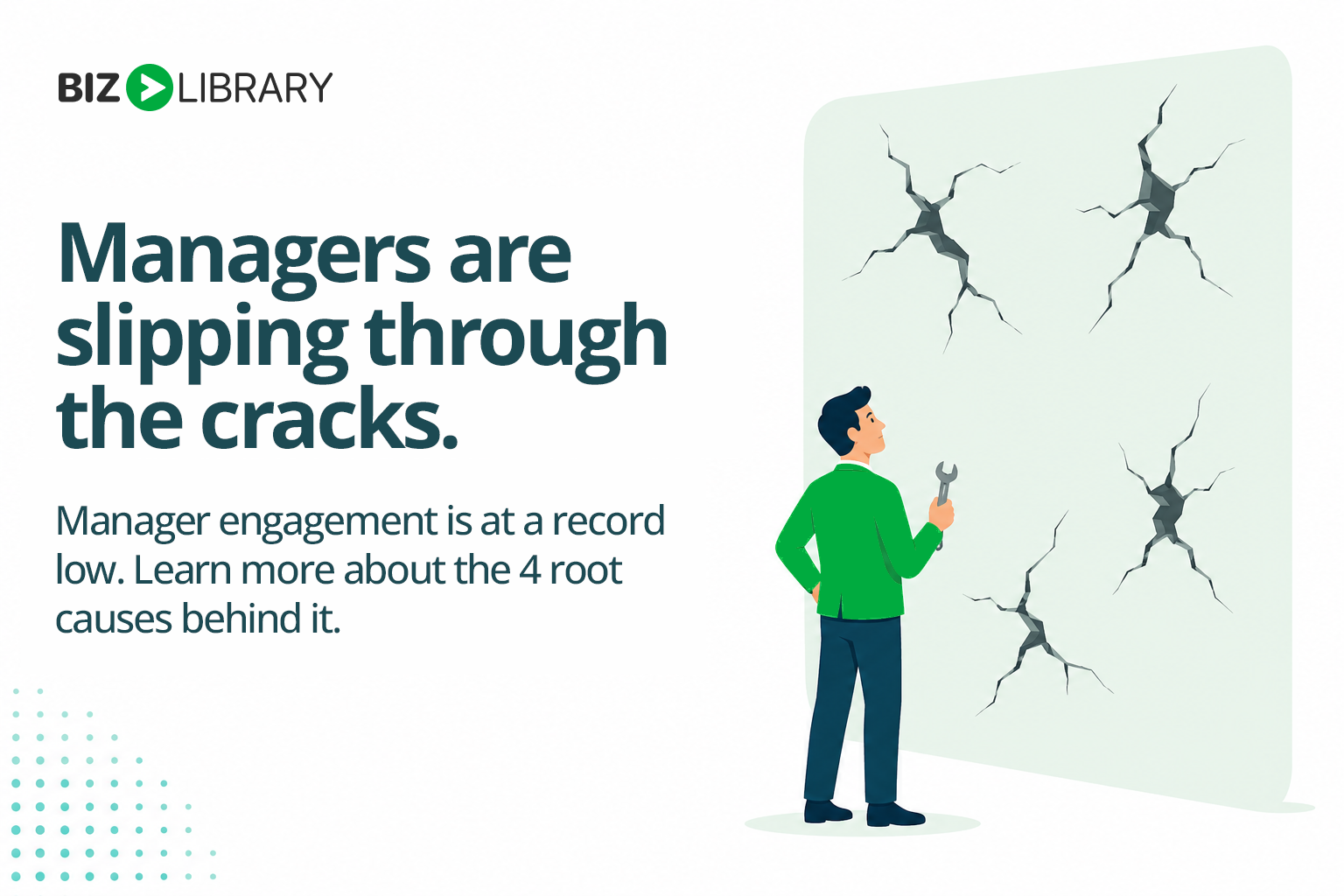

The manager engagement collapse isn’t a training problem. It’s every problem.
Somewhere in the last three years, being a manager stopped being the job with the engagement advantage. Gallup’s 2026 State of the Global Workplace found manager engagement fell from 27% to 22% in a single year — the steepest one-year decline the report has ever tracked for that group. For decades, managers ran hotter than the people they led. More autonomy, clearer line of sight to results, a little more control over their own day. That premium is gone. Managers are now about as disengaged as everyone else, and in some slices of the data, more so.
If your instinct is “so let’s train them to coach better,” you’re not wrong. You’re just early. Coaching is real, it’s proven, and it’s part of the answer. But treating this like a training gap is like treating a leaky roof like a paint problem — the water stain is real, the paint job won’t fix it, and pretending it will just means you repaint every spring while the joists rot underneath.
This is a systemic issue. You can patch the ceiling all you want — if the roof’s still leaking, the stain just comes back.
Why this doesn’t stay contained to “manager satisfaction”
Here’s the part that should worry operations leaders as much as HR: manager engagement isn’t a self-contained metric. It’s upstream of almost everything else you’re already accountable for. Here’s the shape of it at a glance — then the full picture below.
Retention
DDI’s research found nearly 40% of frontline leaders say they aren’t getting adequate coaching — companies with strong coaching cultures are 2.9x more likely to retain top talent.
Safety and compliance
Compliance culture gets reinforced daily by an engaged supervisor noticing a near-miss — not by an annual training module.
AI adoption and ROI
Employees whose manager champions AI are 8.7x more likely to say it transformed their work — yet under 1 in 3 managers do.
$10T
Gallup ties the global engagement decline to roughly $10 trillion in lost productivity — the kind of number that gets a seat at the board meeting, and makes some eyebrows raise.
Retention
DDI’s research found nearly 40% of frontline leaders say they’re not getting adequate coaching from their own managers — and companies with strong coaching cultures are 2.9 times more likely to effectively retain top talent than those without. That’s not just “employees leave bad managers,” the old HR proverb everyone’s heard a thousand times. It’s a compounding chain: disengaged managers coach less, undercoached leaders disengage too, and now you’ve got a leadership bench that’s thinning from both ends at once.
Safety and compliance
This one doesn’t show up in the manager-engagement headlines, but think about how compliance and safety culture actually gets reinforced day to day — it’s not the annual training module, it’s the supervisor who notices something’s off and says something before it becomes an incident report. An overwhelmed, disengaged manager is less likely to catch the near-miss, less likely to have the coaching conversation about a shortcut someone’s taken, less likely to be present enough to notice the pattern at all. Compliance training can only do so much when the person meant to reinforce it daily is running on fumes.
AI adoption and ROI
Here’s a genuinely surprising one from Gallup’s report: in organizations investing in AI, the strongest predictor of whether employees actually adopt the tools — more than the technical rollout itself — is whether their direct manager actively champions it. Employees whose manager visibly supports AI use are 8.7 times more likely to say it’s transformed how work gets done. And yet fewer than one in three employees at AI-adopting companies say their manager is doing that. You can buy the best tools on the market. If the manager layer is checked out, your AI investment sits there, expensive and unused, like a treadmill in a spare bedroom.
The business case, in dollars
Gallup ties the broader engagement decline — now at a global low of 20% — to roughly $10 trillion in lost productivity worldwide. Nine percent of global GDP. This is the kind of number that gets a seat at the board meeting — and makes some eyebrows raise.
So when we say this is systemic, we mean it plainly: a disengaged manager layer leaks into retention, safety, compliance follow-through, tech ROI, and the bottom line, more or less simultaneously. Coaching training addresses exactly one of those leaks. Let’s talk about why the others don’t close on their own.
Ready to close the gap for your managers?
See how BizLibrary helps managers build coaching skill, reclaim capacity, and lead with confidence.
Four camps, at a glance
Camp one: skills gap
Coaching is a trainable skill. Gallup and DDI data both back this as the strongest single lever, if used alone.
Camp two: capacity problem
Half of workloads leave no room for training at all. You can’t train your way out of a math problem.
Camp three: pipeline problem
65% of leaders were promoted on results, not people skills — and it shows in their engagement.
Camp four: role-design problem
Admin load, not aptitude, may be the real time thief — and some of it is genuinely automatable.
Camp one: it’s a skills gap, and it’s fixable
Let’s give this camp its due, because it’s the one with the cleanest data behind it. Gallup found that participants in manager coaching programs saw engagement rise up to 22% for themselves and up to 18% for their teams, with manager performance metrics improving 20–28% — and these effects held for nine to eighteen months after training ended. DDI’s research backs this up from a different angle: coaching culture as a retention lever, not just an engagement one.
The logic here is straightforward and honestly kind of comforting: most managers were promoted for being good individual contributors, not for being good at developing other people, and coaching is a trainable skill, not an innate trait. Teach it, and the numbers move. This is the camp that makes the strongest case for solving this issue with training alone.
Camp two: it’s a capacity problem, and training won’t touch it
Here’s the uncomfortable follow-up question: what happens when you train someone to coach and then don’t give them a single spare minute to do it?
TalentLMS’s 2026 research found that 50% of learning leaders and 53% of employees say heavy workloads leave no room for training at all — even as 65% of employees report that performance expectations keep climbing. They’ve got a name for what happens next: “learning debt.” Like technical debt in a codebase, it’s the gap between the development people actually need and what they have time to absorb, and it compounds quietly until the whole system buckles under it.
BizLibrary’s own research points at the same wall from a different direction. Many organizations are flattening management layers and expanding spans of control — asking fewer managers to cover more people, more projects, more fires — without redesigning the support structure underneath them. One of the contributors to BizLibrary’s 2026 Performance Paradox report, Heidi Kirby, put it about as bluntly as you can: if this expansion of responsibility keeps happening without real respect for the people carrying it, organizations are going to see fewer people willing to stay in management roles at all.
Sit with that for a second. We’re not just at risk of losing engagement. We may be looking at a future where good people simply decline the promotion, because they’ve watched what it did to the last three managers before them. You can’t train your way out of a math problem. If a manager has forty direct reports and back-to-back meetings until 6pm, “here’s a great coaching framework” is just one more tab open in a browser that’s already crashing.
Camp three: it’s a pipeline problem, and it started before the manager ever got the job
This is the one that tends to get glossed over, and it might be the most important. Gallup found that 65% of frontline leaders got their role because of past results or time served — only 30% said people skills were a meaningful factor in the promotion decision. And here’s the kicker: leaders who were promoted for their individual work results actually showed lower engagement than those promoted specifically for leadership skill.
In other words: a lot of organizations are promoting their best doers and hoping they turn into good leaders by osmosis. Some do. A lot don’t, not because they’re incapable, but because nobody ever checked whether “great at the job” and “great at leading people who do the job” were even the same skill set. (Spoiler alert: they are unfortunately not.)
If this is your organization’s actual root cause, coaching training is treating a symptom of a promotion process that needs its own redesign — not a manager development problem at all.
Camp four: it’s a role-design problem, and AI might actually be part of the fix
A lot of managers have genuine hangups about AI right now, and honestly, fair enough — plenty of it has been oversold, and “just add AI” has become its own kind of eye-roll. But there’s a real, specific case for it here, worth separating from the hype: a meaningful chunk of what’s crushing managers right now is administrative load — status updates, scheduling, low-value reporting — that technology can actually absorb, freeing up real hours for the parts of the job that require a human.
David Kelly, one of the contributors to BizLibrary’s Performance Paradox report, frames the stakes this way: the risk isn’t that AI replaces people, it’s that organizations fail to equip people to work effectively alongside it. Applied to management specifically, that means the opportunity isn’t “give managers one more tool to learn” — it’s “take enough off their plate that they have room to be a manager again.”
This camp doesn’t contradict the capacity argument above. It’s the constructive flip side of it: instead of just saying “managers are too busy,” it asks what, specifically, is eating the time, and whether some of that is genuinely automatable.
See the full picture behind these camps.
Solving the Performance Paradox goes deeper into what Kelly, Kirby, Weber, and Niles-Hofmann are seeing on the ground — managers, burnout, and where AI actually helps.
Get the reportSo which camp is right?
All four. That’s the uncomfortable, useful answer.
This is what makes it a systemic issue rather than a single fixable gap: skill, capacity, pipeline, and role design are all leaking into each other at the same time, and most organizations are only working on one of them. You can send every manager through an excellent coaching certification, and if they’re covering two roles with no time to apply it, engagement won’t move. You can lighten their workload with better tools, and if the person in the seat was promoted for the wrong reasons and never wanted to manage people in the first place, engagement won’t move either. Fix all four and you’ve actually got a shot — because now the manager has the skill, the time, the aptitude, and a role that’s been trimmed down to what a human is actually needed for.
What this actually looks like for you
You don’t have to solve all four at once, and honestly, trying to would burn out your own team faster than it fixes anyone else’s. But it’s worth doing an honest gut check before your next leadership investment:
Skill check: Do your managers actually know how to hold a coaching conversation, or have they just absorbed “give feedback in the sandwich method” from a decade-old training video? (We’ve all sat through that one.)
Capacity check: If a manager wanted to coach their team well this week, do they have the hours to do it? Be honest. If the answer’s “only if they skip lunch and answer emails at 9pm,” that’s your real bottleneck.
Pipeline check: Look at your last five management promotions. Were people skills part of that decision, or did the best individual performer just get the next rung on the ladder by default?
Role check: What’s actually eating your managers’ time right now — coaching and judgment calls, or status reports and scheduling logistics that a better system could absorb?
Whichever answer stings the most is probably where to start.
Resources to go deeper
- Solving the Performance Paradox — the full report behind the Kelly and Kirby references above, with more from Adam Weber and Lori Niles-Hofmann on managers, burnout, and where AI genuinely helps versus where it doesn’t.
- The Performance Paradox: Five Trends Redefining Learning and Performance in 2026 — a faster read on the headline trends if the full report is more than you need right now.
- Developing Coaching Skills of Your Managers and Leaders — the place to start once you’ve confirmed skill is genuinely the gap, not a symptom of the other three.
- 15 Best Leadership Training Content Libraries in 2025 — useful if you suspect your existing library is stacked with courses nobody has time to finish, which, if you made it this far, might sound familiar.
The manager engagement collapse took years to build and it’s not getting fixed with a single webinar or a single course, no matter how good either one is. But it is fixable — it just takes being willing to look at all four cracks instead of patching the one that’s easiest to see.
